

As the northern hemisphere summer draws to a close, from an investment perspective, globally things appear to be in paradoxical states. On one hand, worry. It could be anything from the selection like; will/won’t the Strait of Hormuz reopen and stabilize? or is/isn’t there an AI bubble? or is persistent higher inflation flashing signals of an impending downturn? On the other hand, it’s boom times. Many international equity markets have made recent all-time highs. A consequence of these counter-balancing perspectives is increasing unclarity.
This all makes pulling the trigger on any given investment that little bit more difficult. Particularly with regards to more illiquid types of investment, with longer and more difficult time horizons to read. The result is indecisiveness, where investors are unsure, and in many cases are sitting on the sidelines.
There is a lot of money going to its natural home in such phases—cash. According to the SEC as of June 2026 the Net Assets of US Money Market Funds was $8.4 Trillion (USD) a 13% increase in the past year. While going for safety and waiting may seem to be a sensible approach, sensible usually fails to account for the real cost of lost opportunities. If you as an investor are waiting it out for the ‘perfect moment’ to invest, it is safe to say that you are not alone in waiting and the intensity of the competition for the best opportunities means that these are likely already taken before you get a chance to invest. Thus in practical terms the “perfect moment” often is a lot less optimum than it looked in theory.
Idle Cash and Lost Opportunity
Beyond the issues of waiting while trying to time the market to maximize one’s gains, there is a real investment problem when it comes to actual deployment of capital—it is quite simply difficult, and painfully slow. This is a problem across the board for the individual investor to large private market investment funds.
Private market investing from private equity to credit and everything in between has up until recently, been very much in vogue. It remains to be seen if the highly publicized curbing of withdrawals from large private credit funds run by Apollo, Blackstone and Partners Group, at the beginning of the summer indicate a minor blip in attractiveness or a broader falling out of favor of these substantially illiquid investments.
Many of our readers will be familiar with the J-curve style plot in Figure 1. It shows an illustrative path over the first five year investment period of a $100M PE Buyout fund. This covers the capital deployment phase of the investment’s life cycle.
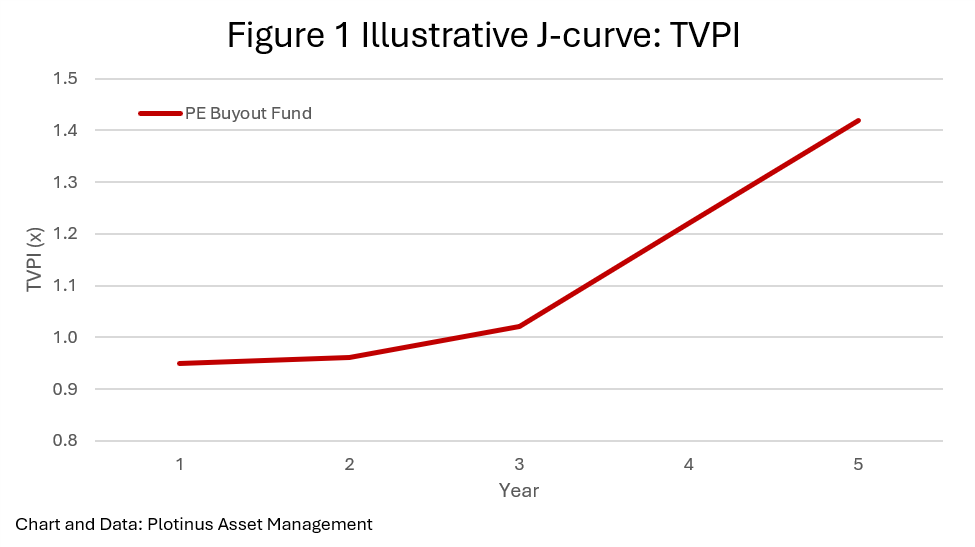
We would postulate that given the nature of the pace of these types of investment, where one can observe a delay between cash paid in by an investor and the cash deployed by the fund manager, are ripe for being made more productive and efficient using an AI trade decision making approach such as our AI Augmented US 500 strategy.
Figure 2 illustrates how, if some of the unallocated capital is allocated to the AI strategy (which is highly liquid) it can help mitigate the drawdown phase that determines the shape of the J-curve in its initial 0–to-3 year period.
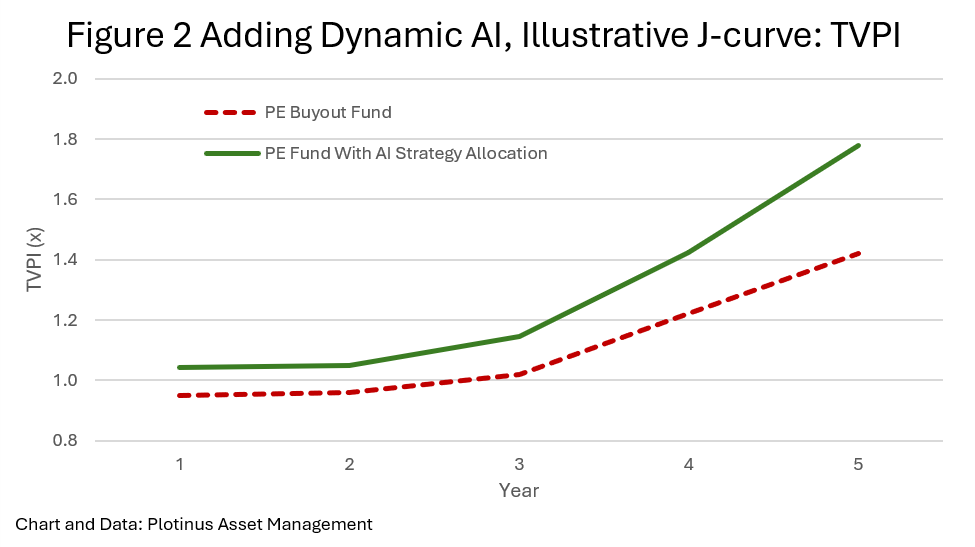
In the example shown, the allocation utilizes 10% of the called capital. Critically this addresses the early misalignment that can occur between manager and investor where management fees taken on the full committed capital are one of the major factors impacting the drawdown of the fund in its early phase. By promoting early stage growth, this unlocks earlier investor gains, while the PE investments incubate, it also gives the manager more breathing space and scope to make their core portfolio investment decisions.
Broad Application
It is worth noting that the example shown above is not limited to a PE fund example. It is also applicable in many other situations. For example sophisticated investors making their own hands-on direct investments. Whilst in this case there is not the drag of management fees, there are inevitably the costs of sourcing and evaluating potential investments but most importantly there is the time involved in the investment process from idea inception to execution. This is true regardless of what the investment is, be it a straightforward real estate investment or the building of a complex bespoke personal portfolio. The approach is applicable anywhere where this type of pre-execution waiting period exists, when cash may seem to be the obvious choice. It is worth bearing in mind that using a highly capital efficient product with low volatility and low drawdown can turn those waiting periods into times of cumulative growth.
If you would like to discuss how your investments could be aided by applying a dynamic AI strategy allocation, please contact the Plotinus team to schedule a conversation. ■
© 2026 Plotinus Asset Management. All rights reserved.
Unauthorized use and/or duplication of any material on this site without written permission is prohibited.
Image Credit: Funkyart-images.